
Conservative treatment including Physical Therapy will improve 80% of TMJ problems
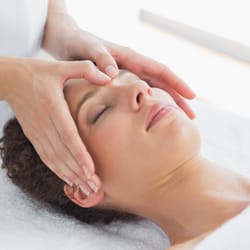
TMJ Physical Therapy is an integral part of TMJ treatment from conservative therapy through post surgery recovery
How do I do TMJ Physical Therapy?
Step 1: Warm your muscles
Use a warming pad on your muscles of your jaw and temples. This should be moist heat.
Eat hot soup or another warm food like oatmeal. It is important that you don't need to chew this meal.
Spend some time on this step: 10 to 20 minutes at night before bed.
Step 2: Massage
Massage your muscles with gently circular motions. You will probably feel some trigger points where you feel more pain. These are tight bands of muscle that are scarred or spasmed. Pay extra attention to these areas and work out the scar and bands. This kneading motion will increase blood flow to the area. As you decrease muscle tension, there will also be an increase in blood flow. Your body knows what to do from here. Your goal with massage therapy is to let your bodies immune system and healing capabilities take over.
Step 3: Stretching
Step 3 is to stretch your jaw and muscles. This is done by slowly and gently opening your mouth wider and wider. Much like if you were going to do the splits, you can't just jump and land in the splits. You need to gradually stretch your muscles to allow an increased range of motion. Be careful and gentle as you gradually open wider and wider. This is called passive stretching. Active stretching is done by using an external force like your fingers or a "therabite" to stretch your jaw.
According to studies, the main effects of stretching are:
- improvement in range of motion
- short-term pain relief
- viscoelastic changes in tendon muscle unit
- decrease of muscle contraction (4.5% to 28%)
The Rocabado 6
Mariano Rocabado is a famous physical therapist with expertise in TMJ Dysfunction. He developed the following exercise routine for the TMJ. The goal of the routine is to reprogram and reset your muscles to position your joint in the right place.
Before we get to the steps, you need to use proper posture:
Posture Goals:
Promote relaxation
Decrease pressure at the TMJ
Provide good head and neck posture
Decrease muscle tension
Be a starting point for all TMJ exercises
Directions:
Relax. Put everything else aside. Focus on this. Release tension from your body.
Keep your teeth slightly apart
Place your tongue to the roof of your mouth as if to make a "clucking" sound.
Imagine two strings. One is pulling straight up from the crown of your head and the second is pulling your breast bone up and out.
Breath from your diaphragm. Smooth, deep breaths.
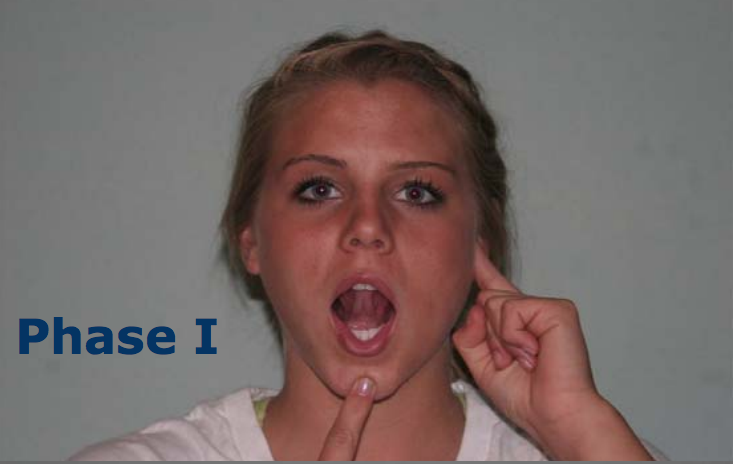
Phase 1: TMJ Rotation control
Goal:
- Restore appropriate tracking
- Decrease clicking, popping
- Limit TMJ to rotation
Directions:
- Place the tip of your tongue on the roof of your mouth as if your were going to make a "cluck" sound.
- Place one index finger on the TMJ with greatest problems.
- Place your other index finger on your chin.
- Using the guidance of your index finger, allow your jaw to fall down and back toward your neck.
- Watch in the mirror while you do this to ensure straight opening and closing.
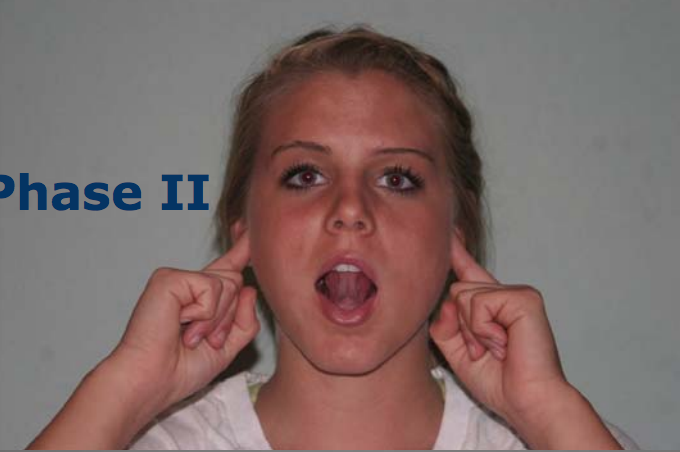
Phase 2: TMJ Rotation and Translation Control
Goals:
- Restore tracking of the TMJ.
- Decrease clicking and open locks
- Limit TMJ opening to rotation
Directions:
- Keep tongue in your "clucking" position.
- Place both index fingers on your TMJ's, one on each side.
- Allow your jaw to fall down and back to your neck.
- Watch the exercise in the mirror to ensure straight opening and closing
Maintain your tongue on the hard palate while opening and closing the jaw. Limit your opening to about 1 finger breadth. This movement allows to jaw to simply rotate (as opposed to rotating and sliding). This range of motion is to also be utilized during chewing, to control hypermobility (preventing being locked open).
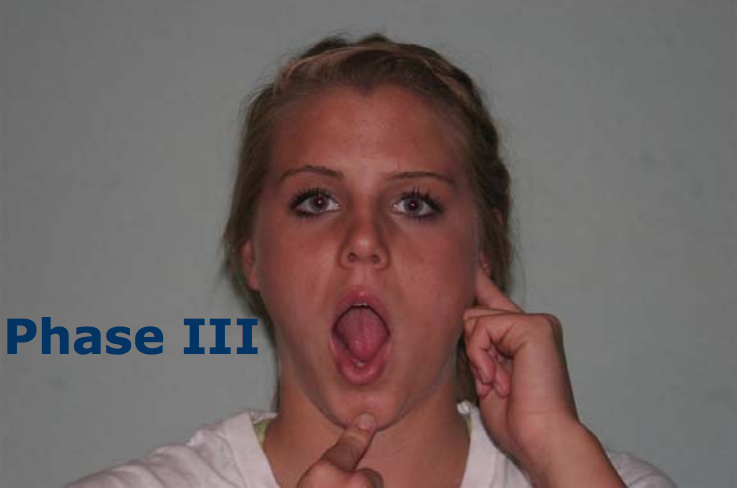
Phase 3: TMJ Rotation and Translation Control
Goals:
- Restore timing of TMJ rotation and sliding
- Restore appropriate tracking to the TMJ
- Decrease clicking and "open lock"
Directions:
- Start in the "clucking position"
- Place one index finger on the TMJ that is worst.
- Place other index finger on chin
- Allow jaw to fall down and back toward your neck with index finger guidance.
- Drop your tongue from the roof of your mouth and complete opening.
- Monitor in the mirror to ensure straight closure.
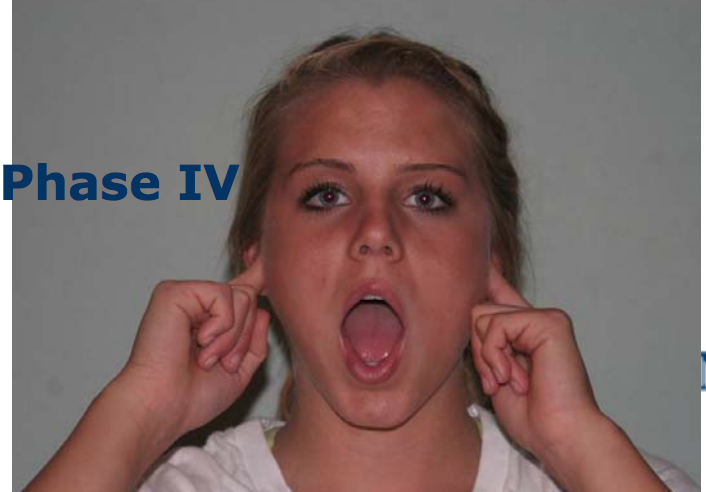
Phase 4: TMJ Rotation and Translation Control
Goals:
- Restore timing fo movements to the TMJ
- Restore tracking of the TMJ
- Decrease clicking and open locks
Directions:
- Begin in the "clucking" position
- Put an index finger from each hand on each TMJ
- Allow your jaw to fall down and back to your neck
- Drop your tongue from the "clucking" position and complete opening to maximum opening
- Monitor for straight opening and closing in the mirror.